How Strong Is the Obfuscation?
In one sentence: obfuscation strength is measured in how much time, skill, and tooling it forces an attacker to spend, not in whether it's "unbreakable", and layering name obfuscation, string encryption, control flow, and code virtualization, as Skater does, is what pushes that cost from trivial to impractical for most attackers.
No .NET obfuscator, Skater included, makes reverse engineering impossible, computer science research has formally shown that a general-purpose, perfectly secure obfuscator cannot exist. What obfuscation strength actually measures is cost: how long, how skilled, and how well-tooled an attacker needs to be. Skater's strength comes from layering independent techniques, name obfuscation defeats casual decompile-and-read attacks, string encryption stops literal-value extraction, control-flow obfuscation defeats static analysis of method logic, and Ultimate Edition's cloud-backed code virtualization removes a handful of the most sensitive routines from the shipped binary entirely. Each layer raises the cost of the next attack step; together they make casual and moderately skilled reverse engineering impractical, while a well-resourced, determined attacker can still eventually work around any single layer given enough time.
Why "how strong" beats "is it unbreakable"
.NET assemblies compile to Intermediate Language (IL), a structured, self-describing format that has to preserve enough information for the CLR to execute it correctly at runtime. That's a fundamental constraint: unlike a fully compiled native binary, IL cannot be stripped of all structure without breaking the program. This isn't just a practical limitation, it's been proven formally. A landmark 2001 cryptography paper by Barak, Goldreich, Impagliazzo, Rudich, Sahai, Vadhan, and Yang showed that a general-purpose "virtual black box" obfuscator, one that hides everything about a program except its input-output behavior, is mathematically impossible to construct for arbitrary programs. Any vendor claiming truly "unbreakable" obfuscation is overstating what's technically achievable.
What obfuscation can do, and what "strength" should actually measure, is raise the practical cost of reverse engineering: the time it takes, the tools required, and the skill level needed, to the point where casual and moderately motivated attackers give up, and even skilled attackers need meaningfully more effort than working with an unobfuscated assembly. The academic literature on this, going back to Collberg, Thomborson, and Low's 1997 taxonomy of obfuscating transformations, formalizes exactly this trade-off with three metrics: potency (how much harder the code is to understand), resilience (how well it resists automated deobfuscation), and cost (the performance/size overhead it adds). That's the standard Skater is designed against.
Myth vs. Reality
| Myth | Reality |
|---|---|
| "Obfuscated code can never be read again." | Decompilers can still open and display an obfuscated assembly's IL structure; obfuscation makes it unreadable and hard to follow, not invisible. |
| "Obfuscation is the same as encryption." | Encryption hides data behind a key; obfuscation transforms code so the CLR can still execute it directly, with no decryption step for the bulk of the logic. Skater does use encryption specifically for string literals and virtualized code fragments, layered on top of structural obfuscation. |
| "If it's obfuscated, it's secure." | Obfuscation protects code from being read and understood. It doesn't replace secure secret storage, transport encryption, or server-side validation of anything security-critical, see OWASP's MASVS-RESILIENCE guidance below. |
| "Free and paid obfuscators offer the same real-world protection." | They often differ in how many independent techniques are layered (naming only vs. naming plus string encryption, control flow, and virtualization), which is what most determines practical resistance to a skilled attacker. |
| "Stronger obfuscation always means slower or bigger software." | Name obfuscation and string encryption are nearly free performance-wise. Only control-flow obfuscation and code virtualization carry a measurable, and controllable, overhead. |
| "Once I obfuscate, I never need to re-test or re-evaluate." | Deobfuscation tools improve over time, and your own code changes with every release. Strength should be periodically re-verified, not assumed permanent from a single pass. |
Obfuscation strength against different attackers
| Attacker | Typical goal | Effect of layered Skater obfuscation |
|---|---|---|
| Curious end user with a free decompiler (ILSpy, dotPeek) | Poke around, see how the app works | Effectively stopped, unreadable member names and scrambled logic make casual browsing pointless. |
| Semi-skilled developer trying to decompile-and-recompile a copy | Rebrand, resell, or steal a working copy of the app | Effectively stopped for most naming conventions, output can't be cleanly recompiled, especially with the '?' naming option. |
| Reverse engineer using static + dynamic analysis (dnSpy, debuggers, tracing) | Bypass a license check or extract a specific algorithm | Substantially slowed, not stopped, control-flow obfuscation and string encryption add real analysis time; a skilled attacker with enough patience can still work through it. |
| Well-resourced, dedicated attacker (organized cracking group, well-funded competitor) | Fully defeat protection on a high-value target | No obfuscator, Skater included, claims high confidence here, code virtualization raises the cost further by removing the most sensitive fragments from the binary, but a determined, well-funded attacker can eventually work around any single protection layer given enough time. |
Comparing obfuscation tiers
Strength also scales with how many independent techniques a given obfuscation approach actually layers together, not just which single technique is used:
| Approach | Casual decompile | Recompile attempt | Static analysis | License-check tampering |
|---|---|---|---|---|
| No obfuscation | Fails to stop | Fails to stop | Fails to stop | Fails to stop |
| Basic renaming only (many free tools) | Stops | Partially stops | Fails to stop | Fails to stop |
| Renaming + string encryption (typical mid-tier commercial) | Stops | Stops | Partially stops | Partially stops |
| Skater Professional (renaming + strings + Vigorous control flow) | Stops | Stops | Substantially raises cost | Partially stops |
| Skater Ultimate (adds Aggressive control flow + code virtualization) | Stops | Stops | Substantially raises cost | Substantially raises cost, especially if the check itself is virtualized |
Ratings are relative and qualitative, based on the number and type of techniques layered, not a specific measured penetration-test result for any individual product or attacker.
What each Skater layer actually defeats
| Technique | Defeats | Doesn't defeat |
|---|---|---|
| Name obfuscation | Reading decompiled code; recompiling a stolen copy | Dynamic/runtime tracing of program behavior |
| String encryption (native DLL or Cloud Vault) | Grepping the binary for license text, URLs, keys | An attacker who successfully reverse-engineers the decryption routine itself |
| Control-flow obfuscation (Vigorous) | Manual and automated static analysis of method logic | Runtime behavior observation with a debugger (dynamic analysis) |
| Control-flow obfuscation (Aggressive) | More sophisticated static and semi-automated deobfuscation tooling than Vigorous alone | A determined attacker willing to invest significant manual analysis time |
| Code virtualization (Ultimate, cloud-backed fragments) | Full reconstruction of the protected fragment from the shipped binary, it's simply not there to extract | Attacks on the network channel or the client's own runtime environment; not a fit for high-frequency hot paths |
Because each technique defeats a different class of attack, combining them is what separates genuinely strong protection from an assembly that only looks protected. A build with name obfuscation alone is meaningfully weaker than the same build with string encryption and control flow layered on top, even though both would show up as "obfuscated" in a quick decompiler check.
Decision matrix: which technique for which asset
| What you're protecting | Minimum recommended technique | Reasoning |
|---|---|---|
| General application logic, UI code, non-sensitive utilities | Name obfuscation (Standard) | Stops casual decompilation and recompilation; low overhead is appropriate since the code isn't uniquely sensitive. |
| License text, activation keys, internal URLs, connection strings | String encryption (Professional) | Prevents an attacker from simply searching the binary for the exact text they need. |
| Proprietary business logic, pricing algorithms, unlock conditions | Control-flow obfuscation, Vigorous or Aggressive (Professional/Ultimate) | Raises the cost of static analysis enough to deter all but the most determined attackers from reconstructing the algorithm. |
| License-check routines and other small, high-value logic | Code virtualization (Ultimate) | Removes the fragment from the shipped binary entirely, the strongest available option for a small number of routines. |
| Cryptographic private keys, payment credentials | Not client-side obfuscation alone | These belong server-side or in a hardware-backed secure store; obfuscation should protect the surrounding logic, not substitute for keeping the secret off the client. |
Benchmark-style example: protecting a license check
Using Collberg's potency/resilience/cost framework qualitatively, here's how a single, realistic asset, a license-validation method, fares under increasing protection:
| Protection applied | Potency (confuses a human reader) | Resilience (resists automated deobfuscation) | Cost (overhead) |
|---|---|---|---|
| None | None | None | None |
| + Name obfuscation | Low–Medium | Medium | Negligible |
| + String encryption | Medium | Medium | Very low |
| + Control-flow obfuscation (Vigorous) | High | Medium–High | Low–moderate |
| + Code virtualization (Ultimate, this method only) | Very high | High | Low overall (first-call network fetch only) |
This table illustrates how protection compounds across layers using Collberg et al.'s potency/resilience/cost terminology; it is a conceptual example, not a benchmark measured against a specific attacker or tool in a lab.
Comparison of .NET Protection Strategies
| Protection Technique | Prevents Reverse Engineering | Slows Reverse Engineering | Typical Runtime Overhead |
|---|---|---|---|
| Symbol Renaming | Low | Medium | None |
| String Encryption | Medium | High | Very Low |
| Control Flow Obfuscation | Medium | High | Low |
| Code Virtualization | Very High | Very High | Medium |
| NativeAOT Compilation | Medium | Medium | None |
| Assembly Encryption Alone | No | Low | Low |
The strongest .NET protection is achieved through a layered security approach. Individual techniques such as symbol renaming, string encryption, or control flow obfuscation each increase the cost of reverse engineering, but none is sufficient on its own for high-value commercial software. By combining multiple protection layers,and applying code virtualization to the most sensitive routines,developers can dramatically increase the time, expertise, and resources required to analyze or tamper with an application while keeping runtime overhead within acceptable limits.
What security research says
Authoritative sources on obfuscation strength
- Barak, Goldreich, Impagliazzo, Rudich, Sahai, Vadhan & Yang, "On the (Im)possibility of Obfuscating Programs" (CRYPTO 2001), the formal result showing that a general-purpose "virtual black box" obfuscator cannot exist for arbitrary programs, which is why no obfuscator can be truthfully marketed as absolute or unbreakable. Referenced widely in the cryptography literature; see the original CRYPTO 2001 proceedings.
- Collberg, Thomborson & Low, "A Taxonomy of Obfuscating Transformations", University of Auckland Technical Report #148 (1997), the foundational framework defining potency, resilience, and cost as the three axes for measuring obfuscation strength, used throughout this page. cs.auckland.ac.nz, CollbergThomborsonLow97a
- OWASP, MASVS-RESILIENCE: Resilience Against Reverse Engineering and Tampering, frames obfuscation as one defense-in-depth control among several (alongside anti-debugging, anti-tampering, and RASP), not a standalone guarantee. mas.owasp.org/MASVS/11-MASVS-RESILIENCE
- OWASP Foundation, Bytecode Obfuscation community page, states plainly that "almost all code can be reverse-engineered with enough skill, time and effort," directly supporting a cost-based rather than absolute view of obfuscation strength. owasp.org/www-community/controls/Bytecode_obfuscation
- OWASP Mobile Application Security Testing Guide (MASTG), Tampering and Reverse Engineering, defines obfuscation as transforming code and data to make it harder to comprehend and sometimes harder to disassemble, as part of a broader software protection scheme. github.com/OWASP/mastg
Obfuscation strength checklist
Before you ship, verify your obfuscation strength against this list rather than assuming it from settings alone:
- Name obfuscation is applied to public members as well as private ones, for any assembly you don't need external code to reference by name.
- String encryption is enabled for license text, activation keys, internal URLs, and any other literal an attacker would search for directly.
- Control-flow obfuscation (Vigorous at minimum) is applied to proprietary business logic, not just left at default on trivial utility code.
- Your highest-value routines, license checks, pricing logic, unlock conditions, are identified and given the strongest available protection, including code virtualization where justified.
- You've personally decompiled your own obfuscated build with ILSpy or dotPeek and confirmed it's not readable or cleanly recompilable.
- Reflection-heavy code paths (plugin loading, serialization, DI) have been regression-tested after obfuscation, not just assumed to work.
- Genuinely critical secrets (cryptographic keys, payment credentials) are stored server-side or in a hardware-backed store, not relying on client-side obfuscation alone.
- Obfuscation runs automatically on every release build via CI/CD, so protection strength doesn't depend on a developer remembering a manual step.
- You revisit and re-verify obfuscation strength periodically, since deobfuscation tooling and your own codebase both change over time.
Screenshots
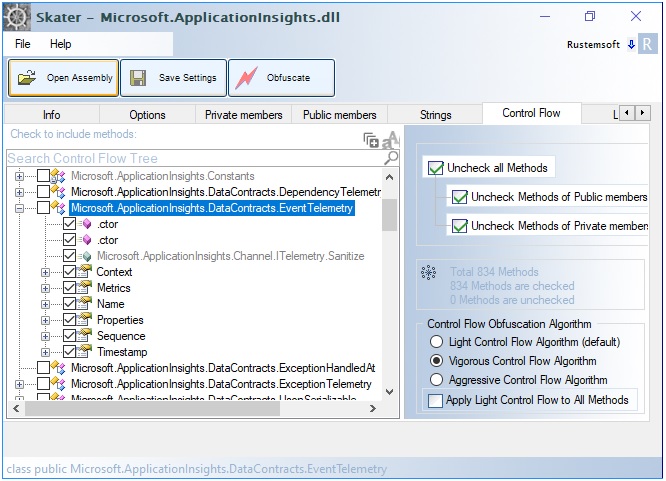
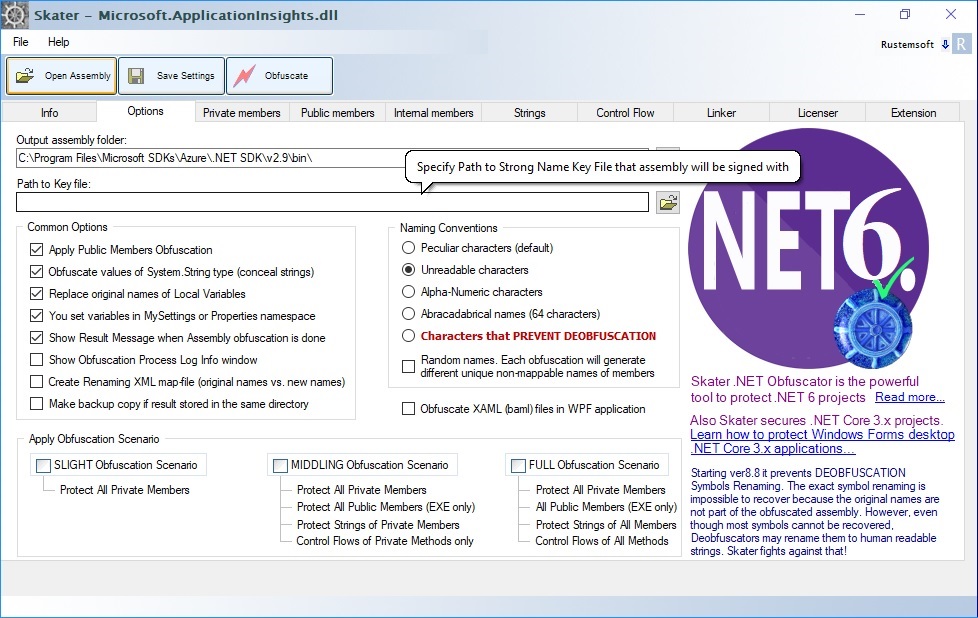
Frequently asked questions
Is Skater's obfuscation unbreakable?
No, and no .NET obfuscator can honestly claim that. Beyond the practical constraints of IL needing to remain executable, a 2001 cryptography paper (Barak et al., CRYPTO 2001) formally proved that a general-purpose obfuscator hiding everything about a program except its behavior is mathematically impossible to build for arbitrary programs. Skater's goal, like any credible obfuscator, is to raise the cost of reverse engineering substantially, not to make it theoretically impossible.
Can a skilled reverse engineer still crack obfuscated .NET code?
Given enough time, tools, and motivation, yes, especially against a single layer of protection. That's why Skater combines name obfuscation, string encryption, and control-flow obfuscation rather than relying on one technique, and why Ultimate Edition's code virtualization goes a step further by removing the most sensitive fragments from the binary rather than just scrambling them in place.
How does code virtualization increase strength over standard obfuscation?
Standard obfuscation techniques transform code that still ships inside your binary, an attacker has the whole assembly to work with, just made harder to read. Code virtualization removes a small number of especially sensitive fragments entirely, executing them at runtime from a cloud-backed interpreter instead. There's simply nothing to extract for those fragments from the shipped file, which is a different and stronger kind of protection than obfuscation alone.
Does stronger obfuscation always mean better protection?
Not automatically, it means a trade-off. Aggressive control-flow obfuscation and code virtualization add real protection strength but also add file size, some runtime overhead, and more testing burden (especially around reflection and serialization). The right strength level depends on what you're protecting: apply the strongest settings to your most sensitive routines, and lighter settings elsewhere, rather than maxing out every option by default. See the decision matrix above.
Should I combine obfuscation with other security measures?
Yes. OWASP's MASVS-RESILIENCE guidance groups obfuscation alongside anti-debugging, anti-tampering, and runtime application self-protection (RASP) as defense-in-depth controls, not standalone guarantees. Obfuscation protects the code itself from being read and understood; it isn't a substitute for secure secret storage, transport encryption (TLS), server-side validation of anything security-critical, or standard secure coding practices.
Does obfuscation strength vary between Vigorous and Aggressive control flow?
Yes. Vigorous applies control-flow obfuscation broadly across selected methods. Aggressive, available in Ultimate Edition, adds selective code virtualization on top for a handful of especially sensitive fragments, meaningfully stronger for those specific routines, at the cost of requiring runtime network access for the virtualized parts.
How can I test how strong my obfuscation actually is?
Decompile your own obfuscated build with a tool like ILSpy or dotPeek and see how much is actually readable or recompilable; check whether known strings still appear in the binary; and time how long static analysis of a protected method takes compared to the unobfuscated version. Use the checklist above as a starting point, and for high-value commercial software, a third-party security review adds confidence beyond internal testing.
Does stronger obfuscation make my application slower or larger?
Somewhat, for the stronger techniques. Name obfuscation and string encryption have negligible performance cost. Control-flow obfuscation adds some execution overhead and file size in exchange for stronger static-analysis resistance. Code virtualization mainly affects performance on first execution of a protected fragment, due to a network round-trip; cached and non-virtualized code run at normal speed.
Does obfuscation protect against dynamic analysis and debugging as well as static analysis?
Less well. Name obfuscation, string encryption, and control-flow obfuscation are primarily strong against static analysis, reading the code without running it. An attacker running the application under a debugger and observing its actual runtime behavior faces a different, generally harder-to-defend-against class of attack. This is a real limitation to be aware of, not a gap unique to Skater.
Is it risky to rely on obfuscation alone for security-critical secrets?
Yes. Obfuscation raises the cost of extracting a secret from client-side code, but it doesn't provide the same guarantees as never shipping the secret to the client at all. For cryptographic keys, payment credentials, or similarly critical material, prefer server-side storage or a hardware-backed secure store, and use obfuscation to protect the surrounding logic rather than as the sole safeguard for the secret itself.
Is there a newer product than Skater with stronger obfuscation?
Yes. Opaquer .NET Obfuscator is Rustemsoft's next-generation successor to Skater, built on the same protection philosophy with a modern architecture and stronger protection techniques for current .NET applications. Skater remains supported and its layered approach reflects the same strength philosophy described here. Read about Opaquer.
Related guides
Pricing, download, documentation & tutorials
Everything you need to evaluate and configure Skater's protection strength: